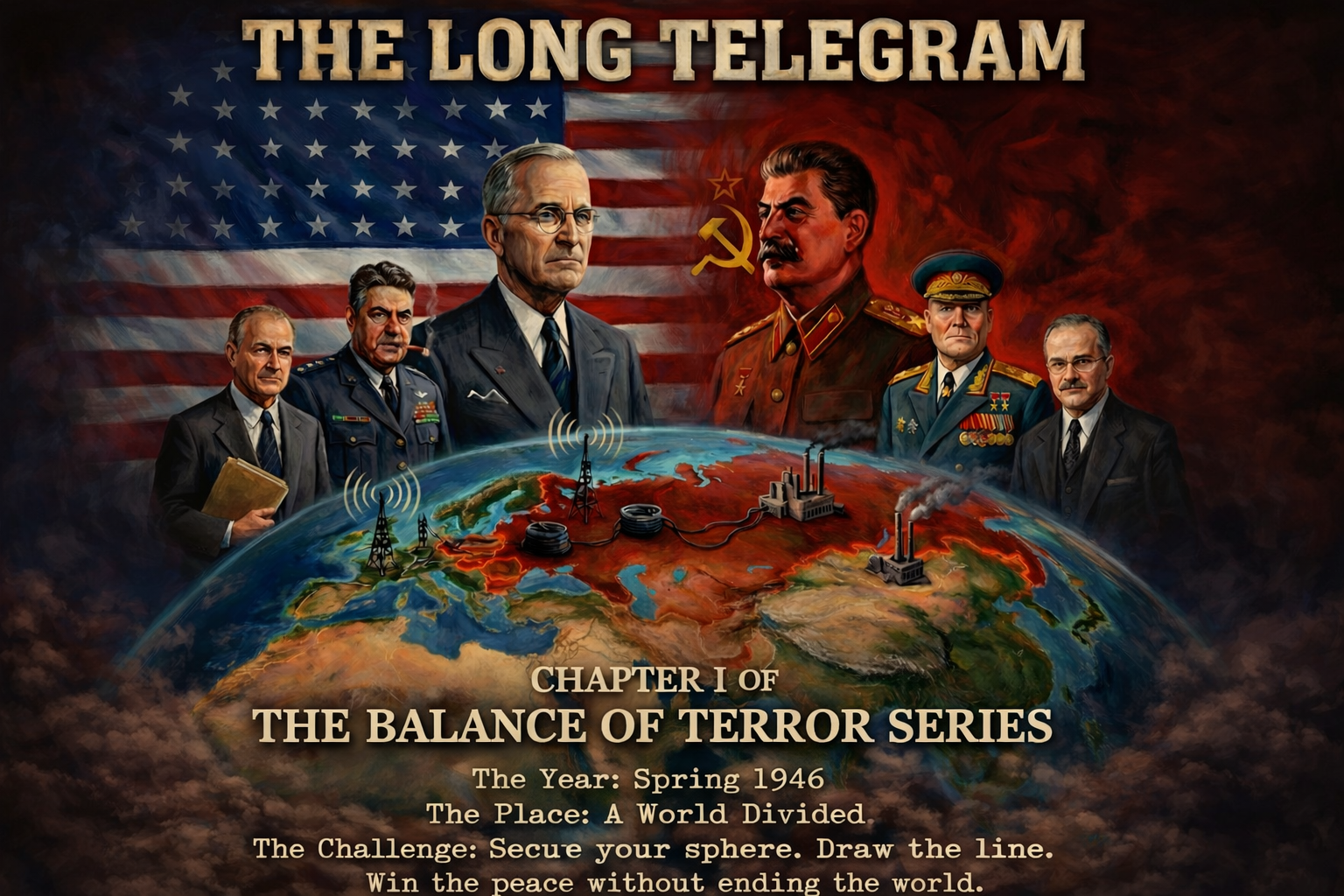
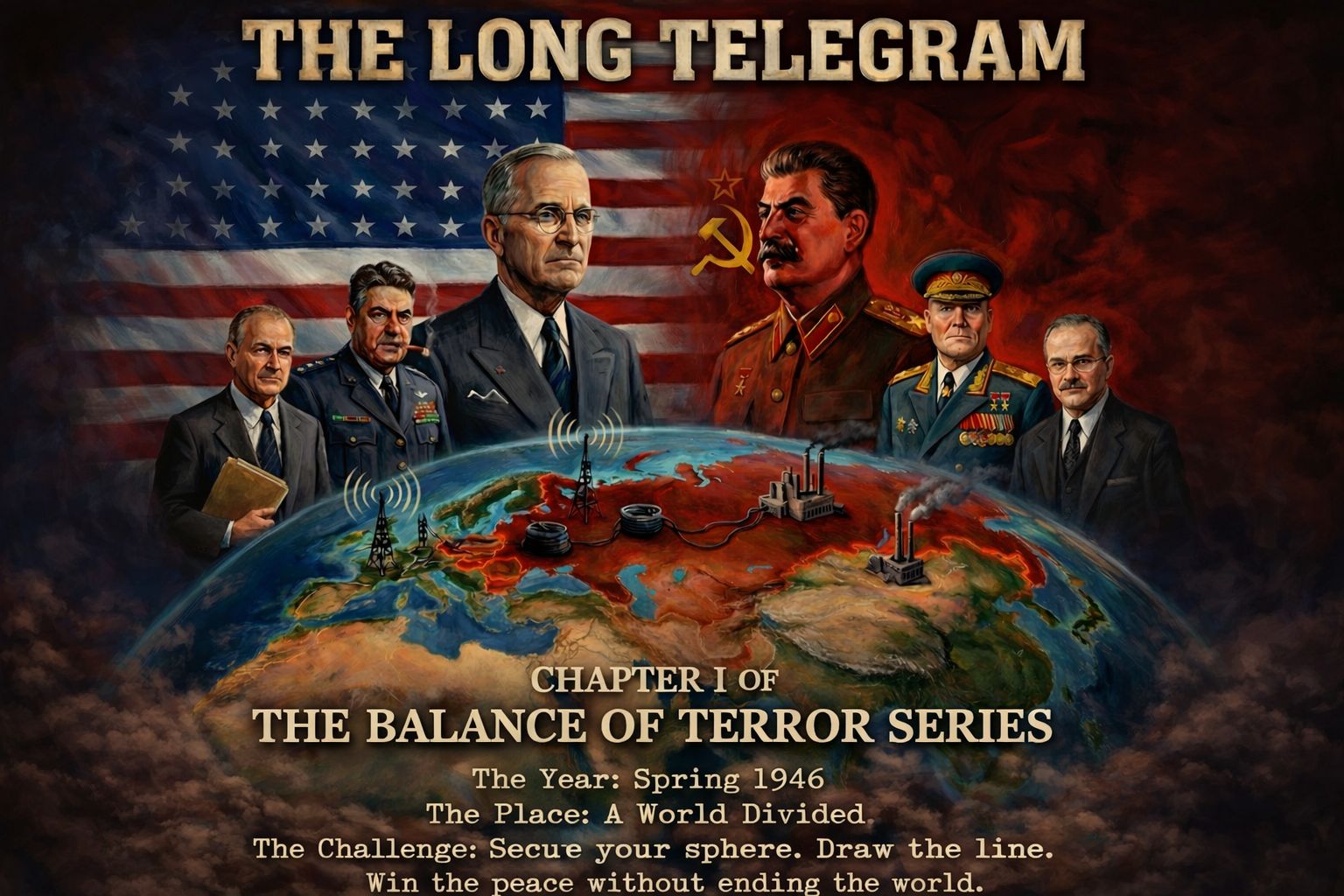
The Long Telegram
February 22, 1946. Moscow.
A junior diplomat named George Kennan sits down at his typewriter in the American Embassy. Over the next eight thousand words, he will reshape the world.
His cable, the "Long Telegram", argued that the Soviet Union could not be reasoned with, only contained. Patiently. Firmly. For decades if necessary.
But containment was only one theory. Others had different ideas.
Curtis LeMay wanted bombers. Henry Wallace wanted peace. Dean Acheson wanted NATO. On the other side, Konev wanted tanks, Molotov wanted vetoes, Litvinov wanted autarky, and Beria? Beria wanted chaos.
You pick the advisor. The doctrine follows.
Eight advisors. Eight ways to win. Eight ways to lose.
The Long Telegram is a Cold War grand strategy game set from 1946 to 1953, the most dangerous years in human history, the years between two world wars and the invention of the hydrogen bomb.
This is not a game about moving armies across a map. It's a game about decisions under uncertainty. You sit in a windowless room with incomplete intelligence, a ticking clock, and the weight of the atomic bomb. Every action, a diplomatic note, an arms shipment, a covert operation, ripples outward in ways you can't fully predict.
Each advisor unlocks a unique doctrine with its own victory condition, special ability, and failure state. Kennan wins through patient containment. LeMay wins through military supremacy. Wallace wins through trust, but one misstep and Congress calls you soft on communism. Beria wins through subversion, but the purge he unleashes may consume him first.
Three rooms. One desk.
The War Room — A ghost map of the world. Regional influence. Crises that demand immediate response. The red phone rings and you choose: back down, escalate, go covert, or take it to the UN.
The Domestic Desk — Congressional support. Party unity. Economic pressure. The home front will break you faster than any foreign adversary.
The Intelligence Hub — The Global Gazette reports what the world sees. The Eyes Only briefings report what it doesn't.
The Red Phone Protocol
Exchange encrypted turn packages with an opponent through async multiplayer. No lobby. No matchmaking. Just two players, two superpowers, and a diplomatic back channel. Play across hours or across days, the Cold War was not fought in real time.
Under the hood:
- 60+ historical events with branching outcomes: the Iron Curtain, the Berlin Blockade, the Soviet bomb, the Korean War
- 19 contested nations with dynamic alignment
- Crisis system with espionage, shadow conflicts, and nuclear brinkmanship
- Asymmetric resources: the US spends Political Capital, the USSR spends State Control
- Each advisor transforms the UI: Beria's Lubyanka basement looks nothing like Acheson's NATO summit chamber
- Optional AI narrative layer: LLM-generated intelligence briefings, advisor memos, and intercepted cables (toggle on/off, never affects gameplay)
"The main element of any United States policy toward the Soviet Union must be that of long-term, patient but firm and vigilant containment."
— George F. Kennan, 1946
Early access build, feedback welcome.
Development log
Leave a comment
Log in with itch.io to leave a comment.